Back in 2014, I asked a question that still sits with me: How and when do the adults in our school receive formative feedback?
We offer our students feedback all day long. We know that confident learners push themselves to reach the next level, and that feedback is how they get there. So how do we seek feedback to learn, grow, and become stronger?
Here is the truth that keeps pulling me back to this work: you can’t see yourself teach. We are so busy noticing students, adjusting on the fly, and keeping the learning moving that we rarely get to step back and watch our own practice. We need someone to lend us their perspective.
Where this started
In 2013, I wrote about Observation of Practice as job-embedded professional development. The next year, in Observation of Practice: Learning Together, I shared what we learned from a small pilot in which teachers observed teachers. I was wowed by the questions, the vulnerability, and the humanity of our conversations. The biggest surprise? The debrief after the lesson mattered even more than the observation itself.
That pilot gave us three reflection prompts I still use:
- What bright spots did I see that affirm my own teaching?
- What questions do I now have about my practice?
- What new ideas do I want to try?
Twelve years later, the questions are the same. What has grown is the range of ways we invite each other in.
Why observation and feedback?
When Trinity teachers have questions about our craft and are determined to hone and enhance teaching, assessment, and relationship-building skills, we turn to each other for advice. We know from the work of Elizabeth City, senior lecturer at the Harvard Graduate School of Education, and the late Richard Elmore, longtime Gregory R. Anrig Professor of Educational Leadership at HGSE, that some of the highest-quality professional development we can offer each other is observation and feedback. Their book with Sarah Fiarman and Lee Teitel, Instructional Rounds in Education, helped shape how we think about looking closely at teaching and learning together.
Kudos to you!
Our faculty members have asked for more observations and more feedback. Please don’t miss how remarkable that is. Asking to be observed is an act of courage and a sign of a learning culture.
There is a name for that kind of asking. In Beyond High Performance, Jason Jaggard draws a line between high performers and meta performers. High performers focus on being the best. Meta performers focus on what they can become. “The best” is a ceiling, and once you reach it, all that is left is defending it. A meta performer keeps asking, “What more am I capable of?”
Because we can’t see ourselves teach, a meta performer asks for a mirror. That is exactly what observation by invitation offers. Each level below is a different way to invite that mirror in. (I wrote more about this and about a 5th-grade teacher who lives this question in What More Am I Capable Of?)
Two phrases guide this work:
- Observation, not evaluation. The purpose is learning and growth, not a rating.
- Observation by invitation. You choose the level, the focus, and the question.
There are four levels to choose from. Each one is a step deeper into reflection and partnership. Pick the level that fits where you are right now, and let a member of the Academic Leadership Team (ALT) know.
Level 1: Drop-in visits
Already in place, ALT members drop in for quick micro-observations. Feedback is often shared verbally, on a Post-it note, or in an Instagram post. These visits are low-stakes and high-frequency. They help us notice and name the good teaching happening in our building every single day.
Level 2: #ObserveMe
#ObserveMe is a movement started by mathematics educator and consultant Robert Kaplinsky to encourage feedback among educators.
As I told Teacher2Teacher back in 2016, the #ObserveMe sign says a few things to me. It says that we are a community of risk-takers brave enough to say, “Here’s what I want to know about my own practice.” It says, “We’re doing the best job we can every day, and you are welcome to drop in at any moment.” And it says we believe we can help each other improve by leaning in and talking about our practice.
Getting started
- Open your copy of the #ObserveMe sign template.
- Add one to three look-fors to your sign, print it, and post it on the outside of your door.
- Invite a member of ALT and your colleagues to come in for an #ObserveMe session.
- Have a conversation about what was observed.
Curious what this looks like in practice? Check out Teacher to Observer, a 2016 Teacher2Teacher article in which Thomas Benefield, Becky Holden, and I talk about how #ObserveMe took root at Trinity.
Level 3: Reflection of Professional Practice
Observation of Practice helps educators seek and gain perspective. At Level 3, an ALT member spends a class period observing and recording what takes place in the classroom. If you have a specific question or goal, it focuses the observation.
The process
- Invite a member of ALT to observe a lesson. Once you settle on a time, send a calendar invitation.
- Share your focus. Have a quick conversation, face-to-face or by email, about your professional practice goal or question.
- Observation. The ALT member observes and shares notes with you within 24 hours.
- Debrief. Meet to talk through the observation and notes, with plenty of time for questions.
Three questions guide our Level 3 work:
- How might we help teachers focus on what is happening in classrooms in a systematic, purposeful, and focused way?
- How might we model and embrace formative assessment of our practice?
- How might we identify, highlight, and celebrate teaching strengths?
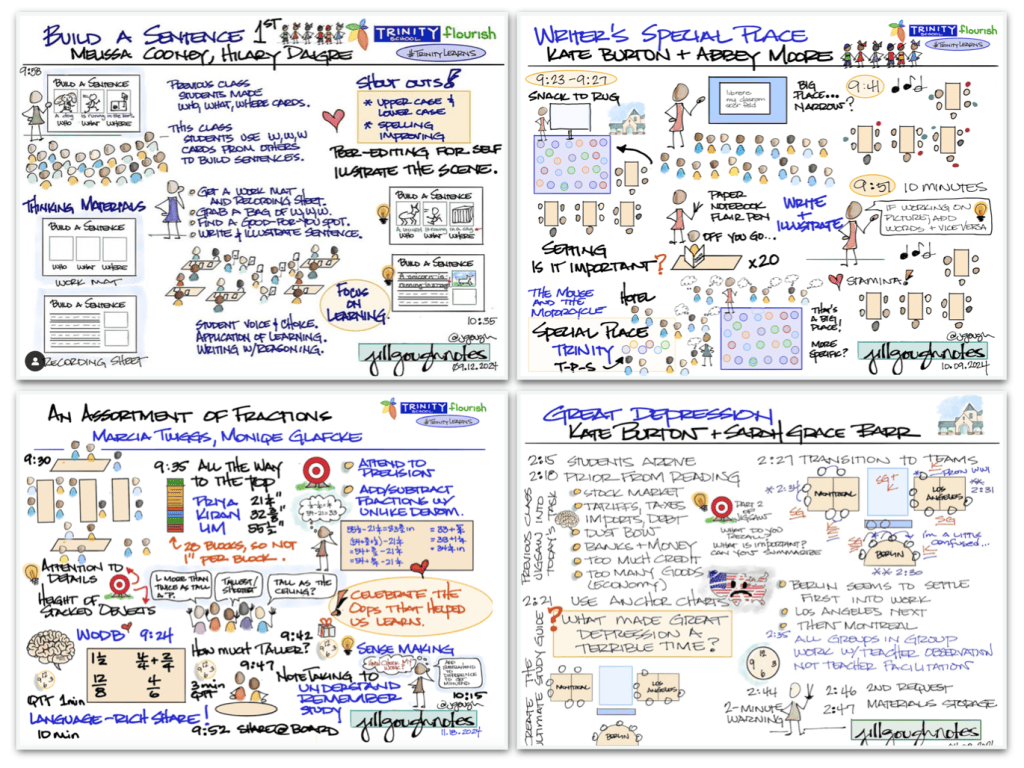
These write-ups are strength-based. The goal is to hold up a mirror so teachers can see their pedagogy and instruction the way their students experience it. A few recent examples, shared with permission:
- Kate Burton: The Great Depression
- Meurisse 5th Grade French: Chapter 3 of La France en danger et les secrets de Picasso
- Twiggs-Glafcke 4th Grade: An Assortment of Fractions
- Burton-Moore Kindergarten: Launch of A Writer’s Special Place
- Cooney-Daigre First Grade: Build a Sentence
And this work goes both ways. Just last week, Marsha Harris observed my 3rd grade lesson and wrote it up as a guest post on The Carnival Conundrum. Seeing my own teaching through her eyes reminded me exactly why we invite each other in.
Level 4: The Impact Cycle
The Impact Cycle, from Jim Knight’s instructional coaching work, is a reflective process in which a teacher and an administrator partner over several rounds of planning, observation, and reflection, all focused on a goal the teacher chooses.
The partnership
- Conversations: We will partner in conversations that are productive, life-giving, and reciprocal by listening with empathy.
- Autonomy: We will honor the teacher’s expertise and the power of individual decision-making.
- Professionalism: Our work will reflect a commitment to quality, professionalism, and the partnership’s individual and collective talents.
- Trust: Our partnership will be grounded in trust and confidentiality during vulnerable moments, without judgment.
- Goals: Goals must center on student improvement and professional growth and mean something to the teacher, providing motivation for success.
What to expect
- Meeting 1: We talk about what you want from the cycle and learn about your classroom.
- Meeting 2: Classroom observation, with video used only by you for reflection.
- Meeting 3: We reflect on the video and lesson to see the current reality, then ask and answer questions toward a meaningful, student-centered goal. Together we agree on a PEERS goal and strategies.
- Meeting 4: Centered on the strategy and progress toward the goal, we plan and launch the next cycle.
The coaching process is cyclical. We meet as needed until your goal is met.
Which level will you choose?
Whatever level you choose, the reflection is where the learning lives. After any observation, I hope you will return to those three prompts from 2014: your bright spots, your questions, and the new ideas you want to try.
The ones doing the talking are the ones learning, and that is just as true for us in a debrief as it is for our students at a whiteboard.
So, what more are you capable of? Which level will you choose? Let a member of ALT know, and let’s learn together.
#TrinityLearns #ObserveMe

