In his first division meeting, Brad Brown, UED Head at Trinity School, shared Jason Jaggard’s Beyond High Performance: What Great Coaches Know About How the Best Get Better. One contrast has stayed with me.
High performers focus on being the best.
Meta performers focus on what they can become.
“The best” is a ceiling. It is a fixed point, and once you reach it, there is nowhere left to go but defending it. “What more am I capable of?” is a growth question. It has no ceiling. It is the difference between a fixed mindset and a growth mindset, and I got to watch it in action in Kate Burton’s 5th grade classroom on two mornings in a row.
A teacher who keeps asking
Last spring, I observed Kate lead a Great Depression jigsaw. Students had become experts on topics such as tariffs, credit, and the Dust Bowl, and their IOC teams were building an “ultimate study guide” together. The lesson was strong. What struck me most was Kate’s restraint. She watched before stepping in and letting students do the thinking. I closed that write-up with this: Great teachers don’t rest for very long; they ask, “What more am I capable of?”
Great teachers don’t rest for very long; they ask, “What more am I capable of?”
This fall, Kate invited me back. She did not ask me to confirm what she already does well. She asked me to look hard at three things:
- How she manages transitions (snack to whole group, whole group to independent work)
- How she supervises the 95% of the class who are working while she confers with individuals
- The language and mentoring moves she uses in conferences. Is she helping students level up, or is she “just cheerleading or being Big Brother”?
What I Observed
Snack and transition (10:15 to 10:31). Students returned from PE/WL/LT and settled into snack while the lesson title, Writing an Introduction: Informational Writing, was already displayed on the ClearTouch. The talk was lively: lunch, “Grandma Got Run Over by a Reindeer,” and how many days until Christmas. Students grouped themselves socially (girls talking, boys on a laptop), and one student used the time to catch up. Kate called time at 10:23 (5 minutes) and again at 10:27 (1.5 minutes). The alarm went off at 10:29 with clear expectations: close tabs, put away materials, games, and snack. At 10:30, Kate thanked the students who were ready. By 10:31, the class was gathered on the rug and couch.
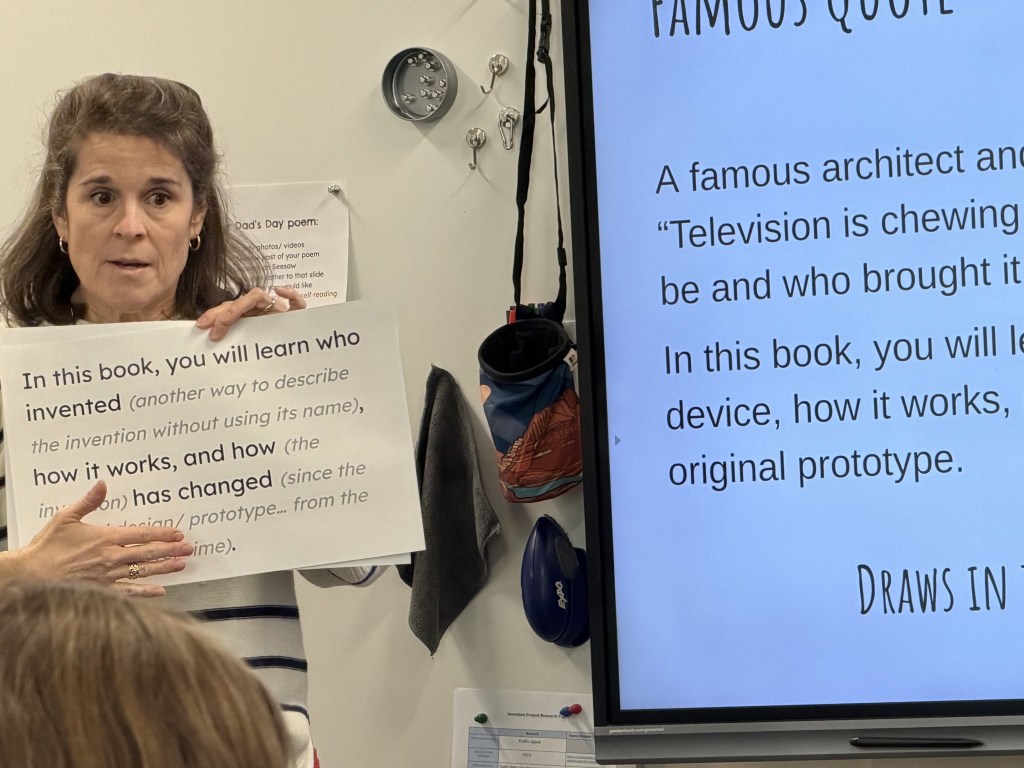
Mini-lesson (10:31 to 10:47). Kate named the priority first (Inventions introduction), then started with something students already knew: how did The Sisters Grimm begin? In the forest. That set up her question: how do we make informational writing just as compelling? She named two jobs for an introduction, the hook and the preview, and went through hook types with examples:
- A hook from a mentor text about television. Kate asked, “What do you notice the author has done?” and “Can the reader visualize?” She tied it to the Notice and Note signpost Contrast and Contradictions.
- Asking a question
- Facts and statistics, which also connect to contrast and contradiction
- A quote (Frank Lloyd Wright)
- Bold beginnings
Kate asked students to hold their questions during instruction. At 10:43, she showed a recommended template, connected it back to the television mentor text, and posted the work priorities:
- Inventions project introduction
- Inventions Chapters 2 and 3
- Chapters 1 through 5
- Finish Dads’ Day post
- Reader Response #5
- Holiday presentation
Kate told students they could move themselves up on the conference list if they needed her. She dismissed them in a controlled way at 10:47, answered a few questions, and the room was settled by 10:48.
Independent work and conferences (10:48 to 11:14). Kate conferred with Mac, Sophia, another student, Quinn, Charlie, Julie, and Conner, with Finley on deck. Libby also brought her a question. Resources were posted on the board and in Google Classroom. Students mostly worked on their own and stopped to help each other when someone needed it. At 11:14, Kate moved the class into prep for science and math before recess.
Strengths Observed
- Predictable transitions. The countdowns, the alarm, and the ordered list of steps let students manage themselves. Thanking the ones who were ready shows the expectation without shaming anyone.
- The lesson was visible before it started. Having the title up during snack primed students for what was coming.
- Starting from what students know. Opening with The Sisters Grimm tied a new genre to a reading experience they already had.
- Mentor text plus inquiry. “What do you notice the author has done?” put the analysis on the students, and the template tied back to the same television example, so the tool came out of the model.
- Connections across the curriculum. Linking hooks to the Contrast and Contradictions signpost connects reading and writing.
- Structures that free up the teacher. The posted priorities, resources in two places, and students moving themselves up the list let Kate see seven or more students in about 25 minutes.
- Conferences that push thinking, not just cheer. Kate’s moves were specific and tied to criteria. “How’s it powered?” and “How does this help?” ask the writer to think like a reader. “Three questions, or two if they’re robust” names a quality standard. That is coaching toward the next level, not cheerleading, and nothing in my notes looked like Big Brother.
- A community of helpers. Students helping each other during work time shows a culture where Kate is not the only source of help.
That invitation is the meta performer move. A high performer protects the reputation. A meta performer asks for a mirror. You can’t see yourself teach, so Kate asked someone to hold the mirror up.
Day 1: Routines that run without the teacher
Transitions. The lesson title, Writing an Introduction: Informational Writing, was on the ClearTouch while students were still eating snack and talking about lunch and how many days were left until Christmas. Kate gave a five-minute warning, then a minute-and-a-half warning. When the alarm went off, she named exactly what to do: close tabs, put away materials, games, and snack. Then she thanked the students who were ready, rather than correcting those who weren’t. About two minutes later, everyone was gathered on the rug and couch.
The mini-lesson. Kate started with something students already knew. How did The Sisters Grimm begin? In the forest. So how do we make informational writing just as compelling? She named two jobs for an introduction, the hook and the preview, and used a mentor text about television to ask, “What do you notice the author has done?” and “Can the reader visualize?” She tied hooks to the Notice and Note signpost Contrast and Contradictions, so students were reading like writers and writing like readers.
Structures that free the teacher. Before anyone moved, Kate posted a prioritized work menu: the Inventions introduction first, then chapters, then other work, with the holiday presentation unlocked only after the core work was done. Resources were available in two places: on the board and in Google Classroom. And students could move themselves up the conference list if they needed her. In about 25 minutes, Kate conferred with at least 7 writers. Students mostly worked on their own and stopped to help one another when someone got stuck.
Those structures answer Kate’s second question. The 95% are supervised by the routines, not just by Kate’s eyes. That is what makes conferring possible.
What more?
Because Kate asked, I offered a few wonderings, and every one of them is a “what more” question, not a “what’s wrong” question.
- Working memory.
The mini-lesson ran about 16 minutes and included a two-part structure, four or five hook types, a template, and a six-item priority list. What would happen if students tried one hook in their own draft before seeing the next one? Could an anchor chart hold the rest? - Protecting the conference.
Twice, students interrupted a conference. Would a visible “conferring” signal or a posted help list protect those minutes? - Who names the next step?
Kate’s questions were doing real work. Could each conference end with the student saying the next step out loud?
That last wondering matters. Hold onto it. Kate did.
For reflection
- What routines in your classroom run without you?
- If you invited a colleague in tomorrow, what three questions would you ask them to look for?
- Are you working to be the best, or to become what you are capable of?
More tomorrow on what happened the very next day.
Thank you, Kate, for the invitation and for modeling what it looks like to keep asking.

