What happens to professional learning after the workshop ends?
Friday 09/25/2026 1:48 p.m.
Dear Kerry and Jill,We are going to do a lesson inspired by our Wednesday Workshop in the EED hub on Monday. If y’all are available at 10:40, we’d love for you to join us!
Abbie and Julianne
Friday 09/25/2026 2:52 p.m.
Hi Jill and Kerry,
Hilary and I plan to do the Frameous lesson in the EED Hub on Monday, Sept. 28th at 9 am, if you’d like to join! No pressure, just wanted you all to know you are more than welcome to come.
Have a great weekend!
M & H
What happens to professional learning after the workshop ends?
That’s the question I carry out of every Wednesday Workshop. We can design a session with clear goals, research-based tasks, and plenty of teacher talk. The real test comes later. Will this be valued enough to use in classrooms with students? This morning, I got to see that question answered twice. It was a joy.
Where We Started: Last Wednesday
In last week’s 1st to 3rd numeracy workshop, Kerry and I set up the UED Hub with magnetic 10-frames on the vertical surfaces. Teachers became learners. After a brief launch of Building Thinking Classrooms norms (e.g., visibly random groups, tasks given verbally, thinking on non-permanent surfaces), teams worked through We’re Frameous.
Each team of three had interdependent roles. One person listened for the first number, another for the second, and a third modeled and scribed the math. No one could do the task alone, so every team had to talk. After each story, we gathered to look at one another’s work. The same story, modeled in more than one valid way.
We ended by giving every 1st grade classroom two sets of magnetic 10-frames. Our hope was simple: that teams would teach with these tools, and that thinking, not answer-getting, would be the goal.
Five days later, it happened.
Two Classrooms, One Task
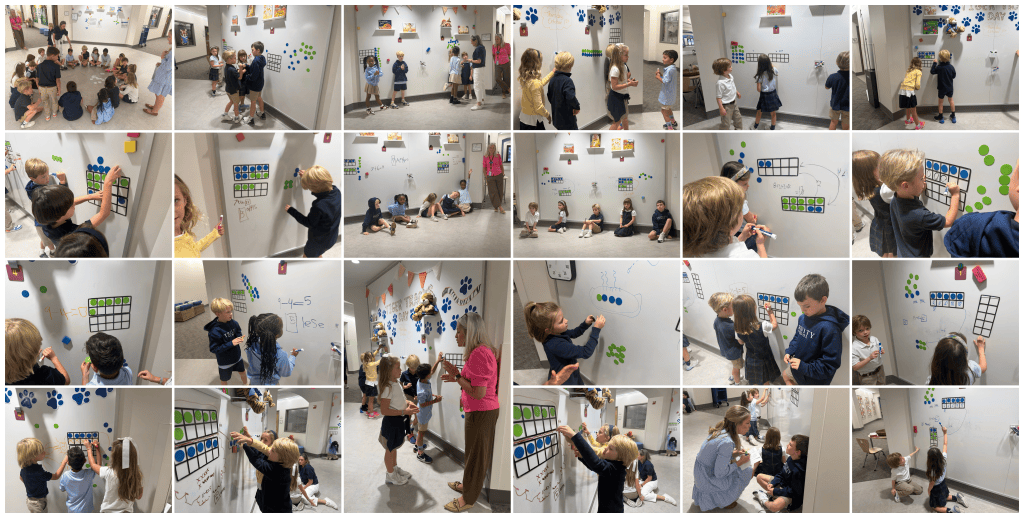
Two of our First Grade teams brought We’re Frameous to their students today. Same task, same tools, same roles. Each team also made its own design choices. Watching both showed me that a task holds up when teachers make it their own.
Hilary Daigre and Melissa Cooney filled the Hub with eight stations. Students gathered in a circle and drew colored cards, with each color indicating a child’s job: listen for the first number, listen for the second, or scribe. Across three stories (apple picking, a pumpkin patch, and leaves blowing away in the wind), the colors rotated so that every child did every job. In the last story, a new direction emerged: Don’t erase. We want to see your thinking. Students took a gallery walk to study how other teams modeled the same story. Then they left the space exactly as they found it.
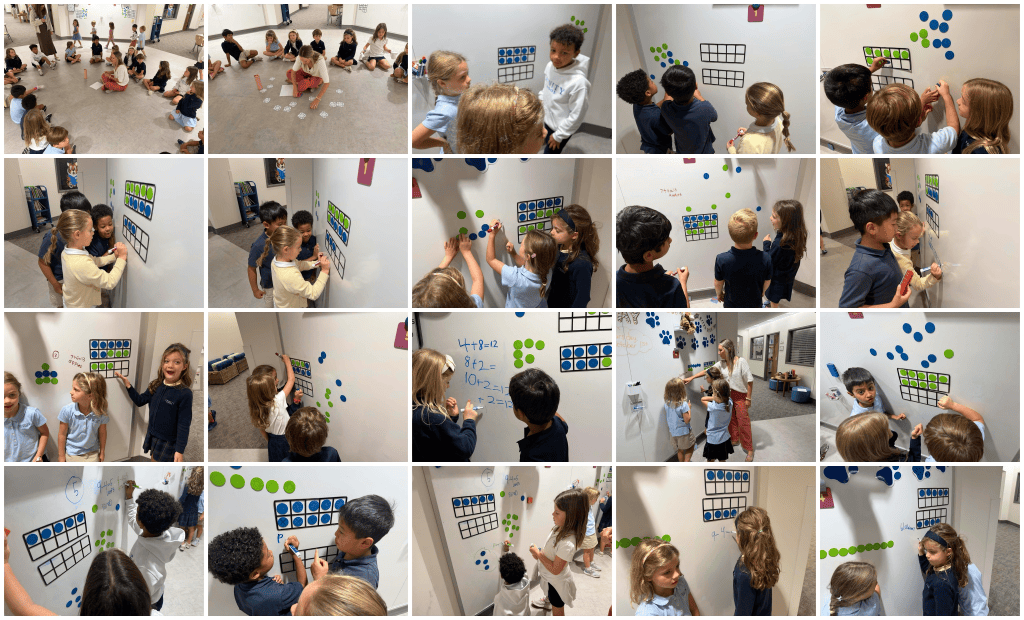
Abbie Shaw and Julianne Schaaf formed groups using tiny dot cards and gave students a choice of roles within clear norms. Their routine was crisp: Listen. Select roles. Turn to listen. Their signature move was stopping after every story. Students sat on the floor, looked at each other’s boards, and noticed and wondered together. Between rounds, a 15-second reset kept things moving. Across four stories, the class moved from sums that cross ten to take-away subtraction. They closed with a question that went beyond the answer: Do you have enough apples to make another pie? Why or why not?
Listen to the Children
Here is what 6- and 7-year-olds said when they were invited to notice each other’s thinking:
S: “I noticed that Group 1 used 4 in one 10-frame and 8 in the other, and moved 2 to complete the 10-frame.”
K: “I noticed some people used X’s and some drew empty circles to show the leaves blown away.”
E: “I like that the blown-away leaves are out of the 10-frames.”
That’s first graders describing other first graders’ strategy for making a ten, and naming it as an equation.
In the leaves story, one student noticed that some teams used X’s and others drew empty circles to show the leaves that blew away. In the apple pie story, students noticed a team that showed the apples “in the pie,” a team that drew the apples “going away,” and a team that used a quick image instead of drawing each apple.
Read that again. First graders are comparing representations of subtraction. They weren’t just reporting answers. They were talking about how to show what happened, which is where the conceptual work lives.
The ones doing the talking are the ones learning. Today, the ones doing the talking were six and seven years old.
What This Tells Me About Professional Learning
Both teams moved from workshop to classroom in less than a week. I don’t think that’s an accident. A few design choices made it possible:
- Teachers experienced the task as learners first. They knew how the roles felt, where the thinking got interesting, and what to look for on the boards.
- The tools went home with them. The magnets were already in every classroom.
- The structure was strong enough to adapt. One team saved the gallery walk for the end. The other built noticing into every round. Both honored the heart of the task: interdependent roles, oral delivery, and thinking made visible.
The goal of our Wednesday Workshops isn’t compliance or coverage. It’s this: teachers leaving the session with something they want to try, and students walking in to find it waiting for them.
Questions I’m Carrying Forward
- When students see the same story modeled in several ways, how do we help them connect those models to one another?
- How might a comparison story (Which is larger, and by how much?) extend today’s take-away subtraction, the way we explored in the workshop?
- What would it look like for 2nd and 3rd-grade teams, now holding their base-10 magnets, to bring Subtraction Is the Main Attraction into the Hub?
- And for all of us: which task from a recent workshop is ready to walk into your classroom this week?
Thank you, Hilary, Melissa, Abbie, and Julianne, for opening your classrooms and letting us see what it looks like when professional learning becomes student learning.

