Every fall, someone sets a lofty goal that makes my stomach flip a little, in a good way. It might be:
- Goal: Every student in my class will be reading on level by winter break.
- Goal: All of my students are fluent in addition and subtraction (or in multiplication) by the end of the year.
- Goal: Retrieval practice woven into my classroom, every day.
Lofty. And…a little terrifying to say out loud, let alone to turn in. The size of the goal is not the problem. The size of the first step is. Take up the challenge to set a lofty, grand goal that impacts student learning.
Start with a lofty goal, then ask: What does just getting started look like?
This is micro-goal, level-up thinking, and it works for goals just as well as for standards. If the goal is the top of the ladder, don’t stand at the bottom staring up. Ask instead: what is the smallest, most doable version of movement toward this? Not the impressive version. The doable one.
- For the goal “every student in my class reading on level by winter break,” the first micro-goal or step might be “pull this month’s data and identify patterns and needs.”
- For the goal “all students fluent in addition and subtraction, or in multiplication,” a first action step might be “give a series of quick fluency checks and note what it tells me.”
- For the goal “retrieval practice woven into every classroom, every day,” make your September action step to “read one good piece on retrieval practice, spaced practice, and/or distributed practice.”
Small enough that skipping it would feel silly. Not so small it doesn’t count.
Micro-actions can be retrieval practice for your goal. We know from the science of learning that spacing things out, a little bit, again and again, beats cramming it all in at once. Goals work the same way. A monthly micro-action: one email, one data pull, one article read closely, keeps the goal retrievable. It stays in working memory instead of getting buried under everything else that’s loud and urgent. A month gives time for an idea to become a habit, not just a task on a list.
What if we treated our own goals the way we ask students to treat theirs, with a progression, not a leap? Consider this when goal setting:
- Ask Brad’s question: “What more am I capable of?” Answer honestly.
- Name your lofty goal in one sentence. No hedging.
- Ask: What would “I am just getting started” look like? Write that as your first step.
- Ask: What would “I’m doing this without thinking about it” look like? That’s the top.
- Fill in three or four steps in between, one for each month between now and then.
- Pick this month’s step. Just this month.
The question I keep asking isn’t “How do I get there?” That’s too big. The question is: “What do I want to be true next month that isn’t true this month?”
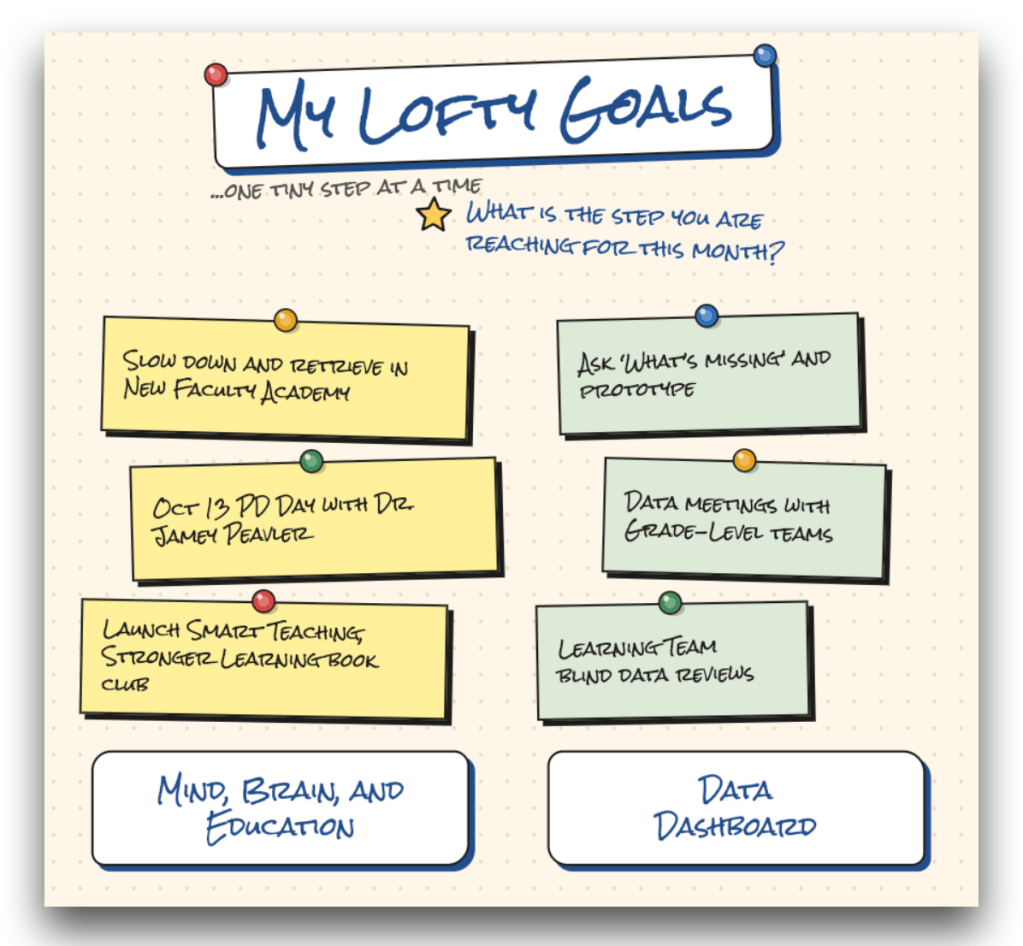
Answer that in one small, doable sentence, and you have your next step. Repeated enough times, these steps create a pathway to your lofty goal and actions that get you closer to knowing what more you’re capable of.
And celebrate the steps when achieved, not just the end goal. Brightspots matter. A win noticed out loud makes the next win feel possible.
What is the step you are reaching for this month?
All of this is easier if you have a partner; maybe you have a teammate who’s interested in the same or a similar goal. And if you want a thought partner or a sounding board, don’t hesitate to reach out to Brad, Marsha, or me.

