What does it look like when every minute of a lesson is a response to what one learner needs today?
On September 23, I sat in on a one-to-one Tier III literacy session with Sarah Mokotoff and a third grader. You can’t see yourself teach, so I try to be a mirror. This morning, the mirror showed me something worth sharing.
Sarah sent her lesson plan ahead of time, and it was detailed and diagnostic. Her objectives came straight from the error summary of the previous session: b/d confusion, -ce at the end of a word, and VCCV words like candy. Those same errors reappeared on purpose throughout the lesson. The plan was not a script to cover. It was a response to what this student needed that day.
The content was a targeted review of consonant-le words. The chunks -fle and -gle were reviewed, and -tle, -ple, and -zle were introduced. Both closed and open first syllables were included, and the new chunks were attached to the doubling decision he already knew.
The lesson, move by move
Scaffold, then release. The lesson opened with letter formation for b and d, then moved on to a new phonemic awareness skill: consonant substitution within blends. “Instead of /s/ say /m/,” and clasp became clamp. Bent became best, nest became next, stacked became stashed. Sarah used chips for the first few items so he could see and touch each sound before holding it all in his head. Then she took the chips away. That is exactly how support should fade.
Sound, spelling, and meaning in two minutes. The three-part drill moved to the ClearTouch board, and he was standing. In the visual deck, Sarah kept going back to the meaning. He identified the nouns, verbs, and adjectives in The crazy bunny hopped toward the dark trees, so the morphemes were tied to real language. The auditory deck asked him to circle the /ē/ in happy, spell drench, produce consonant-le chunks, explain the prefix in redo, and spell kicked.
Rule reasoning, not rule recall. The review of last session’s dictation set up the key move of the lesson: count back three. If the vowel is short, the syllable is closed and the consonant doubles. If it is long, the syllable is open, and nothing doubles. Then Sarah asked about stifle: “Why doesn’t the f double?” She was asking him to explain the rule, not just follow it. Burgle got a definition, not just a decoding.
“Make your pen talk.” For spelling, Sarah gave him two phrases I’ll be repeating: “pound it” and “make your pen talk.” He said each sound as he wrote it. Later, when spelling the new words, he asked, “Can I say the sound as I write them?” He had taken the routine on as his own.
“Did your brain say that didn’t make sense?” During phrase reading, Sarah asked this one question. It teaches a reader to monitor his own comprehension. As he read, she tracked accuracy and prosody together, using scooping to build phrasing, first at the word level and then at the sentence level.
A deliberate choice about time. Near the end, Sarah skipped Learned Words to protect time for dictation. That was a thoughtful decision about what mattered most, not a rush to finish.
What made it work
Crisp and playful at the same time. The pace was brisk, and the transitions were clean. He was in motion, laughing and working, while the lesson stayed faithful to structured, sequential, cumulative Orton-Gillingham instruction. Rigor and joy were not in competition.
Consistent, portable language. “Pound it,” “make your pen talk,” and “count back three” meant the same thing every time. Because the language never shifted, he now has routines he can use to coach himself. His own question during spelling showed that it is already working.
Kind, affirming correction. A young reader who struggles with b and d needs to feel safe being wrong. When he made errors, Sarah corrected them warmly and positively, and the lesson kept its pace. He clearly felt safe.
Connection to research
This lesson reflects the core principles of Orton-Gillingham: explicit, systematic, cumulative, multisensory, and diagnostic-prescriptive. That afternoon, in Michelle Perry’s workshop, she reminded us of the nine principles of OG. I had seen all nine in Sarah’s lesson that morning.
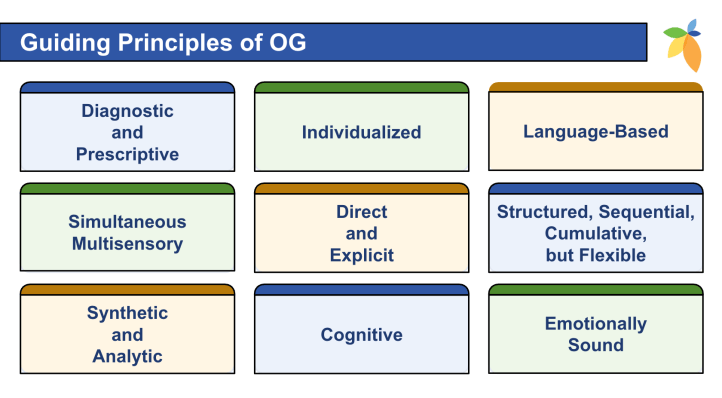
The advanced phonemic awareness work of substituting sounds within consonant blends supports orthographic mapping. Saying each sound while writing builds that sound-to-letter connection over and over.
Scarborough’s Reading Rope gives us another lens. Sarah wove the word-recognition strands (phonological awareness, decoding, sight recognition) together with the language-comprehension strands (vocabulary, language structures, verbal reasoning). A question like “Why doesn’t it double?” is an example of verbal reasoning about spelling.
Sarah’s attention to scooping and prosody aligns with the NAEP fluency scale in her lesson plan, which treats fluency as phrasing and expression rather than speed alone. Through modeling and co-reading, she is leading him from reading in phrases and clauses toward true sentence prosody.
Wonderings
I left the session with two questions I keep turning over.
- As he gets more consistent with count back three, what would it look like for him to generate his own contrasting pairs, like table and tabble?
- How might “Did your brain say that didn’t make sense?” travel with him into his classroom reading, so self-monitoring shows up outside the tutoring room?
This young reader is learning how English works and why it works the way it does. He is also learning that making mistakes is part of getting it right. That comes from Sarah.
Thank you, Sarah, for opening your practice to me and for the detailed lesson plan.
And now I’m curious about you. What portable phrases do your learners carry with them? Where do you ask students to explain the rule rather than just follow it? How do you fade your scaffolds, and how do you know when it’s time?

