What a day. Day 3 of NCSM began with a session that pressed my thinking, moved into my own session, continued with a deep dive into fluency foundations, and closed with the CPAM Leadership Seminar. Then NCTM opened its conference with a keynote that asked the question every learner carries into our classrooms: Do I belong here?
Looking back over my notes and sketchnotes, I see a story running through the whole day. Stories, language, foundations, thinking, and belonging. Here is what I learned and what I am still wondering.
Graham Fletcher: Storytelling, Media, and Student Thinking
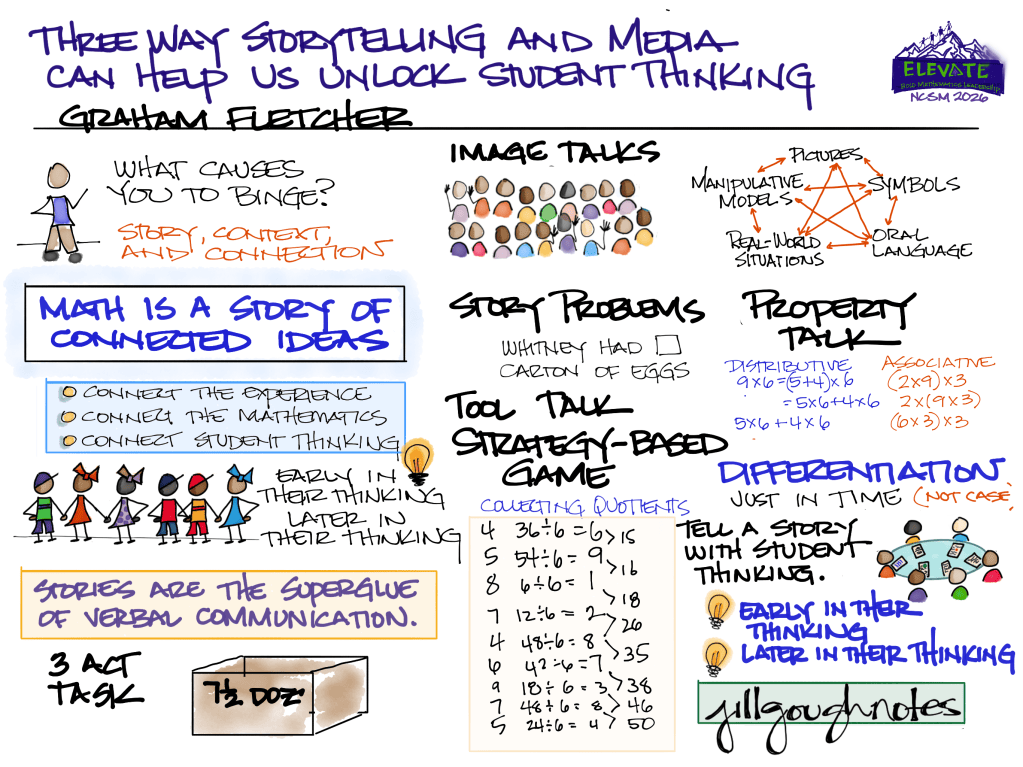
Graham opened with a question: Name a TV show so compelling that you had to watch. What causes you to binge? Our answers came quickly. Story, context, and connection. Then he turned it around. If that is what keeps us coming back to a series, what keeps our students coming back to mathematics?
His answer, boxed in the center of my sketchnote: Math is a story of connected ideas. Our job is to connect the experience, connect the mathematics, and connect student thinking. And because stories are the superglue of verbal communication, the stories we tell help ideas stick.
Graham walked us through routines that invite students into the story:
- Image talks that move between pictures, symbols, manipulatives and models, real-world situations, and oral language
- Story problems with an open start, like Whitney had a carton of eggs, where students decide what matters
- 3-Act Tasks, like the 7½ dozen egg box, that build curiosity before the question is even asked
- Property talk, noticing the distributive and associative properties in action (9 × 6 = 5 × 6 + 4 × 6, or (2 × 9) × 3 = 2 × (9 × 3))
- Tool talk and a strategy-based game, collecting quotients, where the facts live inside play
The idea that pressed my thinking most was Graham’s emphasis on Juli Dixon’s differentiation just in time, not just in case. Graham invited us to tell a story with student thinking, sequencing work from those early in their thinking to those later. Every student sees where they are in the story and where it goes next. No one is left out of the plot.
How often do we plan for what might go wrong instead of responding to the thinking actually in front of us?
My Session: Language-Rich Mathematics Classroom
Next, I had the joy of presenting Language-Rich Mathematics Classroom: Precision, Perseverance, and Sense-Making. This session brings together Math Language Routines and the teaching principles of The Writing Revolution. Our learning targets:
- I can use a writing routine to strengthen my understanding.
- I can listen, speak, read, and write like a mathematician.
We began with one of these is not like the others, four shapes, and a word bank (width, length, area, rectangle, units, square units, quadrilateral, irregular). Participants used sentence expansion to grow a simple kernel: “It is not like the others”-by answering the questions “what” and “why”. Then, we used MLR 1: Stronger and Clearer Each Time. Write a first draft, share it aloud with a partner, listen for feedback, and revise. Listening to our own thinking and the thinking of others makes our explanations more precise.
We talked about speaking versus writing and why both matter. Sentences are the building blocks of good writing. When writing is embedded in the content, it becomes a powerful tool for building knowledge, and the content drives the rigor. Planning and revising are the most important phases of the process.
We also explored note-making versus note-taking. Peter Liljedahl and Maegan Giroux remind us that most students copy notes and never look at them again. Meaningful notes are a record of the meaning students have made.
Thank you to everyone who joined, wrote, revised, and talked. The ones doing the talking are the ones learning.
John SanGiovanni: Leading Intervention for Computational Fluency
John’s session asked a question that has stayed with me all evening: What if the barrier to fluency isn’t the strategy, but fragile foundational skills?
He started by checking our common understanding of fluency. Fluency is much more than knowing facts quickly. It includes efficiency, flexibility, and accuracy, with reasonableness at the center. We solved a couple of problems, shared strategies, and then named the underlying skills each strategy quietly depended on. That was the aha. A student who struggles with a strategy may not need more of that strategy. They may need a stronger foundation beneath it.
What I am taking back to Trinity:
- There are a manageable number of strategies. Too many strategies are not the real barrier.
- Strategies are built on foundations. Things like counting and skip counting, distance to ten, decomposing, multiplying by tens, and doubling and halving are far more important than they appear. Students need to use them with skill and little effort.
- Ask two questions. Does the student understand it? Do they have skill with it? The first calls for teaching or reteaching. The second calls for quality practice.
- Teach, practice, assess, repeat. Practice should be brief, consistent, and connected through routines, games, centers, and independent time. And it takes time.
- Intervention should target the foundation, not everything. “Everything, and drill it” is not a plan.
I am already thinking about our multiplication fluency work through this lens. Where are our students’ foundations strong, and where are they fragile?
To learn more, I highly recommend the Figuring Out Fluency series by Jennifer Bay-Williams and John SanGiovanni.
CPAM Leadership Seminar with Peter Liljedahl
The afternoon brought PAEMST awardees and invited guests together, in person and online, for the CPAM Leadership Seminar. Peter Liljedahl taught us more about Building Thinking Classrooms the best way possible: through experience. He honored the norms of a thinking classroom. Visibly random groups, vertical non-permanent surfaces, and the understanding that thinking is never finished.
We started with Task 6: Split 25 from Mathematics Tasks for the Thinking Classroom, Grades 6-12 by Peter Liljedahl and Kyle Webb. Partway through, Peter had us assess our own collaboration on a continuum from taking turns talking to collaborating. We all pointed at once. Then he asked how we could get better, gathered ideas, and had each group choose one thing to try. Later, we rated ourselves again. For consolidation, his gallery walk was a masterclass in Select, Sequence, Connect from 5 Practices for Orchestrating Productive Mathematics Discussions.
After a break and new random groups, we tackled Task 44: Sectors of a Circle. This time, the continuum ran from rushing to working slow enough. (Yes, you can work too slowly.) For consolidation, teams worked through a note-making task together. Peter closed with a Q&A debrief on the why and the how of his teacher moves. Experience first, explanation second.
Thank you to Texas Instruments for continued support of CPAM and the professional learning of the awardees.
NCTM Opening Keynote: Dr. Russell Ledet, “Do I Belong Here?”
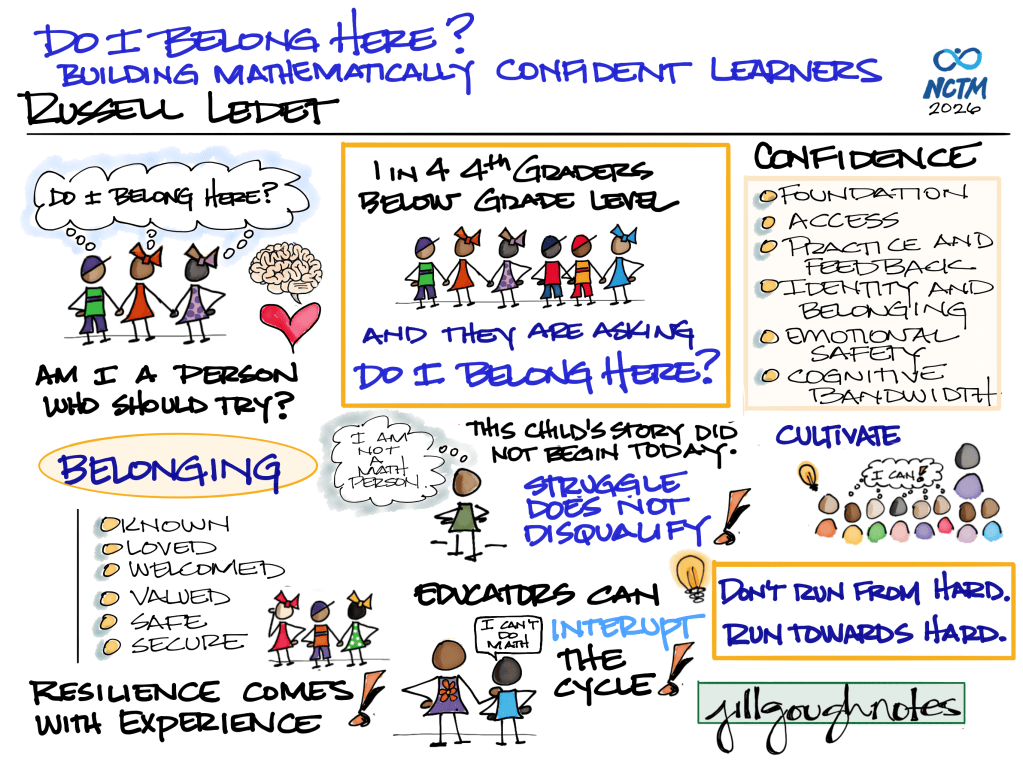
NCTM kicked off with Dr. Russell Ledet and Do I Belong Here? Building Mathematically Confident Learners. He named a hard truth: 1 in 4 fourth graders is below grade level, and they are asking, “Do I belong here?” Underneath that question is another one. Am I the kind of person who should try?
Dr. Ledet reminded us that belonging means being known, loved, welcomed, valued, safe, and secure. Confidence grows from foundation, access, practice and feedback, identity and belonging, emotional safety, and cognitive bandwidth.
The moment I keep returning to: a child who says I am not a math person. This child’s story did not begin today. And yet, struggle does not disqualify. Resilience comes with experience. Educators can interrupt the cycle when a student says I can’t do math, and we can cultivate a room full of students who think I can!
His call to action is the one I am carrying home: Don’t run from hard. Run towards hard.
The Threads That Connect the Day
Each session told part of the same story. Graham showed us that math is a story of connected ideas, and that we can tell that story through student thinking, from early to later stages. Our language routines give students the words and sentences to tell that story precisely. John reminded us that strong stories need a strong foundation. Peter showed us that thinking, collaboration, and even pacing can be named and improved in the moment. And Dr. Ledet reminded us why it all matters. Every student needs to know they belong in the story.
Questions I am carrying home:
- How might we sequence student work so every learner sees themselves in the mathematical story?
- Which foundations are fragile for our students, and how will we know?
- Where can a sentence kernel or a Stronger and Clearer routine help students say what they mean?
- What is one way we can interrupt the I can’t do math cycle this week?
What resonates with you? I would love to hear how you are running towards hard.

