You can’t see yourself teach. That belief is why I am so grateful for the teachers who open their doors and let me sit beside their learners. In October, I spent an hour in Melissa Johnson’s Kindergarten classroom during Fundations, and forty-five minutes beside Samantha Steinberg as she worked one-to-one with a second grader in Tier III literacy intervention.
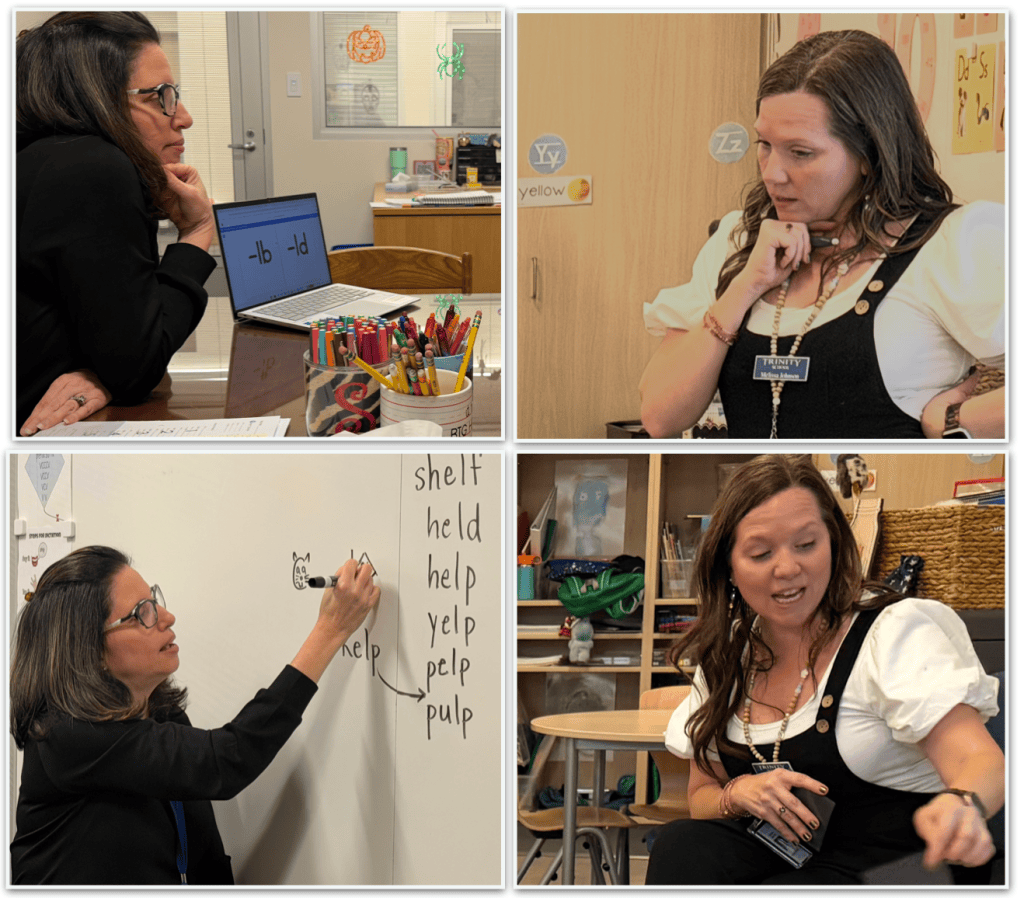
Look at the faces of Samantha Steinberg and Melissa Johnson. That is deep concentration. They are listening closely to our students, not just for the right answer but for how each child is thinking. Some of the most powerful teaching I saw this fall happened in those quiet moments of listening.
On paper, these two settings could not look more different. One is a whole-group lesson on the carpet, with a carpet full of five-year-olds learning two new letters. The other is one child, one teacher, and a small table covered in bumpy paper, markers, and word chains. And yet, as I reread my notes, I kept seeing the same moves.
Same science. Different dose.
Here is what I learned.
1. Regulation and relationship come before rigor
Melissa opened with a clapping pattern that gathered every child’s attention without a single verbal reminder. The class followed with a breathing routine: “Breathing helps me calm down.” Samantha opened by asking her student about her weekend. Pumpkins and Starbucks.
Neither moment took more than a minute or two. Both told learners: this space is yours, and you are ready.
What might shift if we thought of the first two minutes of a lesson as instruction rather than a warm-up?
2. Predictable routines free up brain space for new learning
In Kindergarten, each new letter moved through the same arc: riddles to surface the keyword, attention to how the sound is made in the mouth, a timed brainstorm, a picture page, and letter formation. Because j went first, p moved faster while staying just as rich. Students knew what was coming, so their attention could go to the sound and the letter. Meanwhile, Abbey Moore handled transitions and pulled individual students for support, and those students rejoined without disrupting the flow.
Samantha did something similar on a smaller scale, involving one child. She narrated the shape of the lesson as it unfolded: “We’ve got more.” “We’ve got three more.” “Last -l blend.” Her student always knew where she was.
When the routine is familiar, working memory is free for the content. Predictable is not boring. Predictable is kind.
3. Sound comes first, and the body is a learning tool
Both lessons started with sound, not print. Kindergartners put a hand on their throats to decide whether /j/ is voiced or unvoiced, noticed what their lips and teeth were doing, and then made the mouth movement silently. Samantha’s student added and deleted final phonemes using hand motions, one hand holding the word and the other adding or taking away the final sound, with no print at all.
Then the body kept working: two-finger air writing, finger tracing on bumpy paper, tapping sounds, pounding syllables, and standing with a pointer to read an entire chain of words. Each of these gives a sound a physical anchor. That anchor supports the orthographic mapping that Ehri describes, in which the sound, the mouth, the letter, and the keyword become bound together.
4. Non-examples and student questions are gifts
When Kindergartners offered George, drink, and Dracula as j words, Melissa used the moment to listen for the sound rather than the spelling. She also modeled how not to form a j, starting at the skyline, so students could see the difference. No child was made to feel wrong.
In Tier III, Samantha explained that an ending blend needs a vowel before it. Her student asked, “Can it be in the middle?” Samantha did not answer. She said, “Give me an example.” Together they tapped out leapt and discovered the vowel team in the middle, and then Samantha stated the rule clearly. Later, when her student noticed that the nonsense word pelp is close to kelp, Samantha followed her lead into how we know it is a k and not a c.
The ones doing the talking are the ones learning. In both rooms, the teacher asked rather than told, and the learners did the heavy lifting.
5. Retrieval is woven in, not bolted on
Melissa reminded the class that they had generated 27 r words last time, then set a five-minute timer for a brain dump. The class reached 15 j words and then 23 p words, many of them wonderfully personal: Papa, Piedmont Park, parkour, Pokémon.
Samantha’s session opened with her student rereading her previous dictation and closed with a full dictation that included sounds, real words, nonsense words, trick words, phrases, and sentences. The nonsense words matter. They tell us whether a learner is using the code or relying on memory.
6. Name the thinking, and celebrate the disposition
Melissa asked, “When we sort something in our brain, it is called…” and her Kindergartners supplied schema. Then: “Kiss your brains.” Samantha’s prompts during dictation handed the monitoring back to her student: “Check yourself. You can fix it.” “Oh, is that a blend you know? You were right the first time!”
And then came my favorite moment of the month. At the end of the session, during two minutes of Genius Star, Samantha groaned about a terrible roll. Her student answered, “I like hard things.”
That sentence is the outcome every intervention hopes for. It does not happen by accident. It grows from careful lesson design, immediate and kind correction, and a relationship in which a child feels known.
Same rope, different dose
Both lessons live on the word recognition strands of Scarborough’s Reading Rope: phonological awareness, decoding, and sight recognition. The Kindergarten lesson builds that foundation for a whole class at once. The Tier III session delivers the same principles with more intensity: explicit, systematic, cumulative, multisensory, and responsive to one child in real time.
This is what I most want every teacher to see. Tier III is not a different kind of teaching. It is the same good teaching, more targeted and more often.
Questions I’m carrying
- What would students notice if the j and p brainstorm lists sat side by side? Which words came more easily, and why?
- How might the silent mouth movement return during dictation when a student is unsure which letter to write?
- Where else in our day could a learner ask, “Can it be in the middle?” and hear, “Give me an example”?
- Which routines in our classrooms are predictable enough that students can spend their energy on the new learning?
Thank you
Melissa and Samantha, thank you for inviting me in. Your learners are not just learning letters and blends. They are learning to listen, notice, and think about sounds, and that hard things can be fun.
What are you noticing in your learners this fall? I would love to hear.

